Sagres sits on the corner where two very different coastlines meet. Here is how to read the swell and the wind and pick the side that will actually have good waves.
Ask anyone who surfs here what makes the area special and they will tell you the same thing: the choice between two coastlines. The Sagres west coast vs south coast surf decision is the first one we make every morning, before choosing a beach, a board or a time to paddle out. Get it right and you surf clean waves at the right size. Get it wrong and you spend the session getting washed through or sitting in a lake.
The good news is that the logic is simple once you understand two things: where the swell comes from and which way the wind blows.
Two coasts, one corner
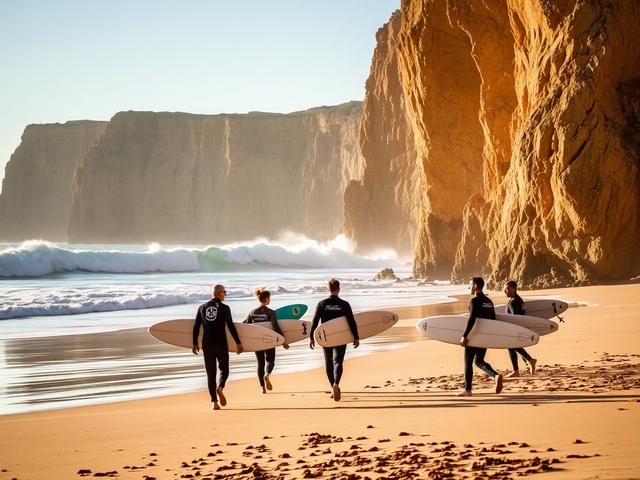
Sagres sits at the south-western tip of mainland Portugal. North of the town, the coast runs up the Costa Vicentina and faces the open Atlantic. East of the town, the Algarve coast runs towards Lagos and faces south, away from most of the swell.
The west coast
The west-facing beaches catch almost every Atlantic swell. Cordoama and Castelejo, about 15 minutes away via Vila do Bispo, are long, exposed beach breaks with several peaks. Further north, Praia do Amado near Carrapateira is the most consistent beach break in the region; we cover it in our Praia do Amado day-trip guide.
The corner spots
Right by town, Tonel faces west on the exposed side of the cape and is the most reliable wave in Sagres. Beliche, on the road to Cape St. Vincent, is a cliff-walled cove that takes the sting out of the swell and some of the wind, which makes it useful when the open beaches are too big.
The south coast
Mareta, in Sagres itself, faces south behind the headland. It is sheltered from the north wind and the direct west swell, so waves have to wrap around the cape to reach it. Further east, Zavial is a south-coast break that comes alive on a big west or south-west swell.
Swell: direction and size decide most days
Most of the swell that reaches Portugal comes from the west and north-west, generated by storms out in the North Atlantic. The west coast faces straight into it. The south coast faces away from it and only gets waves when the swell has a southerly component, or when a west swell is big enough to bend around Cape St. Vincent.
That gives you the basic rule:
Small to medium swell: go west
On a small forecast, the south coast is usually flat or close to it, while the west coast has rideable waves. Cordoama, Castelejo and Tonel are where you start looking. Tonel in particular is the first spot in Sagres to show a wave on a small day.
Big swell: go south, or somewhere sheltered
When a large west or north-west swell arrives, especially in autumn and winter, the exposed west-coast beaches close out and rips get strong. Tonel goes from good to unsurfable quickly. This is when the south coast earns its keep. Mareta may only be a fraction of the size, which is often exactly what you want, and Beliche can stay organised when the open beaches are not. On the biggest west and south-west swells, Zavial is the wave experienced surfers drive to.
Swell period matters too
A long-period groundswell, say 12 seconds or more, wraps around headlands far better than short windswell. A medium-sized but long-period swell can produce decent waves on the south coast, while the same size of short-period swell will barely reach it.
Wind: north and north-west favour the south coast
Wind is the other half of the decision, and it often overrides the swell. Offshore wind, blowing from the land towards the sea, holds the wave faces up and keeps them clean. Onshore wind crumbles them.
On the west coast, east and north-east winds are offshore. They are the mornings worth setting an alarm for at Cordoama and Castelejo. North and north-west winds blow along or onto the west coast and chop it up.
On the south coast, north and north-east winds are offshore. The same northerly that ruins the west coast cleans up Mareta and Zavial. That is why, on a north-wind day, the south coast can be glassy while the west is a mess.
The summer northerly
In summer a north wind, often fresh by late morning, blows on many days. The usual pattern is to surf the west coast early, before it fills in, and switch to the south coast in the afternoon, or to accept smaller waves on the south side for cleaner conditions.
South and south-west winds
Southerly winds are less common but they flip the logic: the south coast turns onshore and messy, and the west coast can be the cleaner option. They often arrive with fronts and rain in winter.
A quick decision guide
Treat this as a starting point, not a rulebook. Tide, sandbanks and local quirks all change the picture, and the beach pages linked above go into each spot in detail.
| Conditions | Where to look first | Why |
|---|---|---|
| Small W/NW swell, light or E/NE wind | West coast: Cordoama, Castelejo, Tonel | The west catches what little swell there is and the wind is offshore |
| Medium W/NW swell, N/NW wind | Beliche, then south coast: Mareta | West coast is choppy; sheltered spots stay cleaner |
| Big W/NW swell, any wind | South coast: Mareta, Zavial for experienced surfers; Beliche | Open west-coast beaches close out; the south gets the wrapped, smaller swell |
| Big W/SW groundswell, N wind | Zavial (experienced surfers), Mareta | The swell wraps in and the north wind is offshore on the south coast |
| S/SE swell | South coast: Mareta, Zavial | The swell hits the south coast directly |
| S/SW wind | West coast, if the swell allows | Southerlies are onshore on the south coast |
| Tiny everywhere | Tonel, or a longboard at Mareta | Tonel picks up swell more easily than anywhere nearby |
Let someone else make the call
Reading forecasts gets you most of the way, but sandbanks move and the same chart can look different on the beach. Local knowledge is what fills the gap. On a lesson we choose the beach for you, usually Cordoama in summer and Mareta when the west is too big or windy. If you already surf, surf guiding does the same job for independent surfers: a local guide checks the swell, wind and tide against your level, picks the break and drives you there.
For an overview of every beach on both coasts, start with our surf spots guide, and if you surf on your own, our rentals let you swap boards as the conditions change.
Frequently Asked Questions
Which coast is better for surfing in Sagres, west or south?
Neither is better overall. The west coast gets more swell and is usually the place to go on small and medium days. The south coast is sheltered and works when the west coast is too big or when north or north-west winds are blowing.
What wind is offshore on the south coast near Sagres?
North and north-east winds blow offshore on the south-facing beaches such as Mareta and Zavial. That is why the south coast is often clean on days when the north wind is chopping up the west coast.
Why is the south coast often flat?
Most Atlantic swell arrives from the west and north-west, and the south coast faces away from it. It needs a south swell, or a big west swell wrapping around Cape St. Vincent, to get good waves.
How far apart are the west and south coast beaches?
Very close. Tonel and Mareta are both in Sagres, and Cordoama and Castelejo on the west coast are about 15 minutes away by car. Switching coasts mid-day is easy.